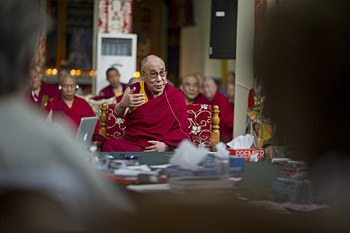
Mundgod, India, January 25, 2013 (by Saskia De Rothschild, International Herald Tribune) — Religion and science have not always been easy friends, as Galileo could attest.
But over the last week scientists and Buddhist scholars have been working in this small Tibetan enclave in southern India to prove that these two worlds can not only co-exist — but benefit each another.
It is the 26th edition of the Mind & Life Conference and the first held in a monastery, for thousands of Buddhist monks gathered here. His Holiness the Dalai Lama, the leader of Tibetan Buddhism, greeted the scientists last Friday and introduced the week-long dialogue about science and religion.
The examination is rooted in the personal story of the Dalai Lama. During his secluded training as a child in Tibet, he would gaze at the night sky through a telescope on the roof of the Potala Palace. He looked at the moon with such intensity he realized the shadows and asperities on its surface contradicted the Tibetan belief that it was lit from within. He took his findings to his tutors.
“When I told my tutors of my interest in science, they replied that it made sense,” said the Dalai Lama during his welcome speech to the conference. “However, although we have an interest in science, that doesn’t mean we have to devote all our energy to it. I spend the majority of my time in meditation on love, compassion and wisdom, which is the source of my interest in science.”
It is this interest he is trying to spark in all Tibetan monks by adding science to their instruction.
“In the Buddhist investigation of reality we traditionally employ four principles of reasoning: dependence, function, nature and evidence,” said the Dalai Lama. Not a far stretch from the way scientists look for evidence. “Both approaches seem to work in parallel,” he said.
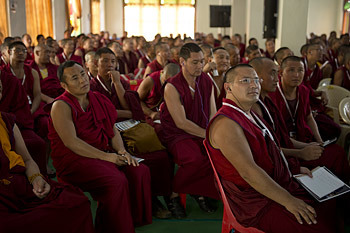
The thousands of monks of the Mundgod monasteries have been asked to follow the discussions — whose topics range from Quantum physics to neuroscience — in the Drepung Loseling Monastery’s assembly hall here. Monks who can’t fit into the hall watch the discussions on overflow screens outside on the monastery grounds.
|
| Some of the many monastics attending the Mind and Life XXVI Conference at Drepung Monastery held on January 17-22, 2013. Photo/Tenzin Choejor/OHHDL |
With a strong emphasis on training the mind through meditation, looking within and constant questioning, the long and arduous teaching young monks have to follow in the monasteries requires the same attention to analysis and logic as any scientific curriculum. One difference? Isolation. In Tibet, before the Chinese invasion, the monks were kept from the outside world, practicing their faith in seclusion.
According to Rato Khen Rinpoche, the abbot of Rato Drepung, another Mundgod monastery, “Monastic vocation used to be cocooned by a geographic isolation.”
Today, things have changed. “Maintaining that tradition is not the way to form the 21st century monk,” he explained during an interview at the monastery.
Rato Khen Rinpoche, the first Westerner appointed abbot of a Tibetan monastery (his given name is Nicholas Vreeland), became a monk at thirty. Before he turned to Buddhism he studied and worked as a photographer.
His worldliness did not deter him from becoming a geshe — the equivalent of a Ph.D. in Buddhism, which requires up to twenty years of study — and now an abbot.
“Bringing science to Buddhist monks does not mean bending the belief system,” he insists, “they are parallel, there is no attempt to harmonize the two.”
For the science conference, Rato Monastery has transformed its prayer hall into a conference hall where 40 monks are getting together to edit a Tibetan science and Buddhist philosophy compendium.
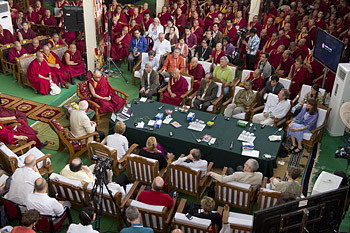 |
| The Mind and Life XXVI Conference held at Drepung
Monastery in Mundgod, India, on January 17-22, 2013. Photo/Tenzin
Choejor/OHHDL |
The monks are Tibetan scholars from all monasteries who followed a multiple-year science course and are now asked by the Dalai Lama to compile what they learned into a book for their fellow monks. “These are monks who have spent from early morning to late night memorizing ancient texts, having them explained by wise elders and debating them long into the night,” says Rato’s abbot. “They had to leave behind Tibetan beliefs in place for centuries and apply the same strict discipline they had in their Buddhist studies to modern science.”
This is the strength of mind required of the modern monk, he says: a capacity for knowledge, open mindedness and debate, carried alongside the absolute belief in Buddha’s words.
The book will cover, along with Buddhist philosophy, the history of Science — from Galileo’s discovery of the planets’ movements to Darwin’s theory on evolution — tackling basic physics, biology and chemistry topics. Once the editing is over, the monks will go back to their respective monasteries and become the first Tibetan monks science teachers for their fellow monks and nuns.
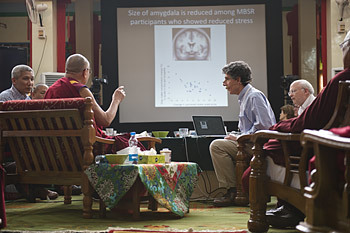
But the curiosity goes both ways. Scientists have long been fascinated by the effect of the Buddhist practice of meditation on the brain. Richard Davidson, director of the laboratory for Affective Neuroscience at the University of Wisconsin-Madison has conducted experiments on a dozen of Tibetan Buddhist monks’ brains.
His findings created a stir in brain science circles by suggesting that after meditating for thousands of hours, monks altered the functioning and structure of their brains.
|
| Richard Davidson during his presentation at the Mind and Life XXVI Conference held at Drepung Monastery in Mundgod, India, on January 17-22, 2013. Photo/Tenzin Choejor/OHHDL |
As part of his ongoing research, Dr. Davidson last year connected French monk Matthieu Ricard to 256 sensors and asked him to meditate on compassion. The scans of his brain showed an extraordinary level of gamma waves (activity linked to consciousness, learning and memory), “levels never reported before in the neuroscience literature”, the scientist said.
The left prefrontal cortex also saw increased activity, proof of a larger capacity for “happiness.”
On Sunday, the topic of discussion between the scientists and the Buddhist scholars was the nature of consciousness. The Dalai Lama asked the scientists where the basis for consciousness lies.
Responses from the scientists differed strongly.
Christof Koch, a University of California neuroscience best know for his work on consciousness, said we could speculate but ultimately we don’t know where it lies beyond the brain, its physical basis. He added that all mammals have consciousness but it is impossible to know where it lies (for example, our immune system can function without it).
Matthieu Ricard, the French monk who was a genetics scientist before taking up the monastic life, turned towards his Buddhist teaching more than his scientific past.
“By honest introspection, by following one line of inquiry which is pure experience,” one can reach an understanding of consciousness, he said.
Ricard then addressed the topic of reincarnation and some individuals’ ability to remember past lives.
Arthur Zajonc, a professor emeritus of physics at Harvard, doesn’t consider himself a Buddhist he said. Yet, he added, “I meditate and through that, have come to believe in the possibility of reincarnation.”
The benefits of meditation and contemplative practice should not only be reserved to monks, Mr. Zajonc added. He explained that they could contribute to the education of any college undergraduate before quoting Albert Einstein: “He who can no longer pause to wonder and stand rapt in awe, is as good as dead.”